
Hip Rehabilitation in a 50+ Client vs. Pro Athlete – More Similarities Than Differences
I have a love/hate relationship with doing “rehab.”
Yes, I know, rehab is just training in the presence of injury. And while that does have merit, it undermines the intricacies of rehabilitation.
If I’m working with an athlete who maybe strains their quad mid-season, that’s certainly just training in the presence of injury/pain. That person already lives in the “training world” so to speak. They know why they’re doing it, have a set goal, and likely don’t have any mental limitations to overcome.
If I have someone has been scared away from exercise, deals with chronic pain, and has little hope; well good luck just “training in the presence of injury.”
This requires far more than just putting together some sets and reps. This type of work, if done right, is rather exhausting, as you’re trying to fight many battles at once. This doesn’t mean competitive athletes don’t need mental coaching too, because they absolutely do. It’s just not quite the uphill battle that it is with someone in chronic pain or with a doom and gloom prognosis from a Doctor.
Before I started scaling back the rehabilitation clients I take, in one year I had:
- Two people with Ehlers–Danlos syndromes (EDS) (extreme joint laxity with multiple dislocations)
- Two MPFL (Medial PF ligament reconstruction + tibial tubercle medialization)
- Three Hip Labrum Tears + Fracture
- One person with THREE labrum surgeries on ONE shoulder (D1 athlete)
- Slipped Capital Femoral Epiphysis Repair
And that’s just the beginning. Because I was able to have success with cases like these, I would get more referrals. Those people need to overcome extreme mental barriers to have success. So it becomes more like, “training while in therapy.” If you can’t get them on board mentally, nothing you do in the gym will matter.
I notice that Physical Therapists are starting to value strength and conditioning principles, which is great to see. I’m going to put a workout I wrote for a Pro Athlete who often struggles with their hips vs. a 50+ client who was training to avoid a hip replacement surgery. I think you will notice that there are more similarities than differences.
Client 1
- 60 years old, no synovial fluid left, “bone on bone”, scheduled for a total hip replacement, hurt to even walk, developed a limp.
- This is a workout from our second month of training (eventually they cancelled their surgery)
Roll/Engage with the client (this is where you need them to be relaxed)
Bird-dog with perturbations (me pushing on her) x reps
Additional ground-based activation
Active/Dynamic movement prep + Dribbles, Skips (fwd/bkwd), submaximal A skips
Box Jump – 3×3
Banded glute iso-hold – 1:30
Peterson Stepdown – 1×15
Trap Bar – 3×6-8 (RPE 6-7)
Split Squat (Contralateral DB) – 3 count eccentric – 2×7
Physioball Hamstring Curl + Straight leg bridge – 2×8-10
Forward + Backward Unilateral DB Farmer carry x 1/e
Summary:
Throughout this session, you’ll need to hold their hand a little. Because they are likely in a hyper-sensitive state, they will often “feel things” or doubt their ability to do certain things.
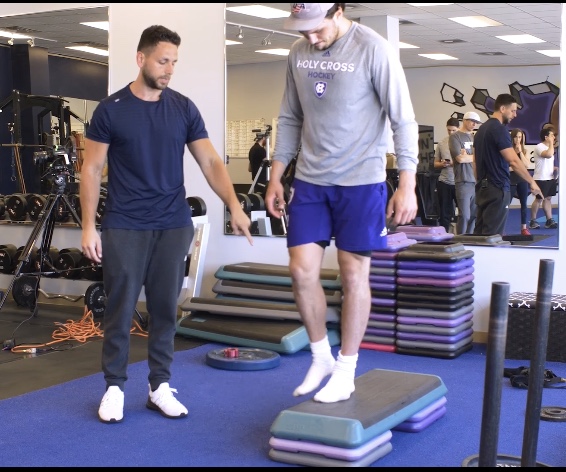
For example, the first time I ever had her do a box jump she was terrified, absolutely terrified. She actually pleaded with me not to perform it, but this was our first real mental obstacle. I needed her to have a win and violate her own beliefs about her hip. Finally, she caved.
The first jump felt a little weird for her, not the best, but manageable. This is partly because she had envisioned a catastrophe. It’s my job to walk you back from that cliff. As she did more, they felt better and better.
The rest of the session is just general training. Because the brain patterns all three contractions uniquely, I like to challenge them all. I also use eccentrics for their ability to lengthen tissue (How I Program Eccentric Training Pt. 1).
Overall volume is low because she is still new to training and doesn’t need as much of a stimulus to adapt. I have no preference in the general means we use (exercises), I only care about what they can tolerate and our ability to stress it and adapt.
Client 2
- Pro athlete, history of hip issues, later stage of career
- Earlier off-season
Roll
Ground-based (just the highlights)
Banded bird-dog (Watch Here)
Adductor lift-offs x 5/e
Side plank with 5 powerful exhalations
Glute bridge x 15 hold last rep 10 seconds
Active/Dynamic Warm-up – Submaximal Power Speed Drills – Accelerations
Low intensive Single Leg Hop Series + skater hop with MB and 2 count hold
X band walk x 15
2 out / 1 back Leg Press (Eccentric emphasis) (this is another option – Watch Here) – 6 count eccentric – 2×6-8
Trap Bar Deadlift – 70% – 4×5
Banded Goodmorning – 2×15
Unilateral, elevated calf raise – 2×12
Top Leg Bent Copenhagen Adductor hold – 2×20-30 sec
Lay on the ground with legs elevated, close eyes, breathe, 1-2 min
Summary:
I’ve been working with this athlete for a while, so I have a good handle on what they can tolerate and what they respond best to/enjoy the most. Often times when coaches or therapists convinces themselves of a “mobility issue”, they just start trying to mobilize the shit out of it. From banded mobilizations to CARs, etc.
But if you understood the intricacies of a complex system (the human body), you would realize your efforts are misguided. Why is there a mobility issue? Is the “issue” actually an issue or are you making it one? Or does it just not reach your goniometer standards, yet the person/player is fine in full-body movements? Maybe it’s their bone morphology? Maybe it’s a stability issue in a nearby joint? Maybe the nervous system has a good reason?
Anyway, we have had success by using eccentrics for the hip flexors, building strength in the lower back/obliques and the hips aka just training with some slight moderations here and there. My advice – work with the body, not against it.
In Closing
If you examine both workouts, there’s a ton of similarities. So on paper, this is where rehab = training, training = rehab. However, this does ignore the psychological component, and that happens to be the most important in my opinion.
If you spend as much time trying to build confidence and earn their trust that you do on exercise selection and sets/reps, your programming will automatically improve.

Leave a Reply