
Analyzing Training Data – If You Don’t Track, You Don’t know
It’s been a whirlwind of a few months as I just finished releasing my latest book (Here). After each summer, I look back at the data and videos that I have from the off-season. I need to see if what I did worked, and how well it worked. I also need to see where I made mistakes, so I can hopefully prevent them in the future.
One more thing. None of this data matters IF sport performance does not improve. Recognize that your job is more important than having someone lift more weight. You need to develop and improve their mental and physical output and capacity.
Max velocity increases ranged from 1.2mph faster (lowest) to 2.6mph faster (highest), with more falling closer to the 2+mph increase.
- There’s a decent gap between the two because I’m using summer data of younger and older athletes, plus those who didn’t train as frequently. I’d prefer to use flying 10’s for this data, but had serious issues with my freelap timing system, so opted for using the Woodway Curve. I recognize that this is NOT the same as running outside, nor will the #’s themselves be exact, but it gives me a way to track the progress.
- If you’ve trained enough people for speed/power, you’ve likely come to the conclusion that improving speed is the most difficult of the biomotor abilities (strength, speed, stamina, suppleness, skill). “Even the guy putting back the weights gets stronger” – Dr. Mel Siff
- Looking back, I think we might need to Max V sprint even more. The struggle for me is the lack of access to a linear, 60+ yard area. You need to consider the time you are spending on each skill. If you’re running 10 minutes, but lifting for 60 minutes, it’s clear where your priority lies. The data continues to show that the strongest are NOT the fastest.
Acceleration times, 10’s, 20s, 30s improved in every athlete tested, with a wide range.
- This makes perfect sense as we dedicated plenty of time and repetitions to acceleration work. To get better at a skill you need to actually do it. Crazy, right? We ran acceleration/speed work 2-3x per week. Obviously the volume and intensity changed.
- Acceleration is highly strength dominant as we know (angles, ground contact times, etc.). Because of this, you will mainly want to focus on weights, medball throws, jump variations (variations with greater knee bend as seen in acceleration, single response then multi, and beginning with more horizontal force production.
- For more on acceleration and how to train it – Read This
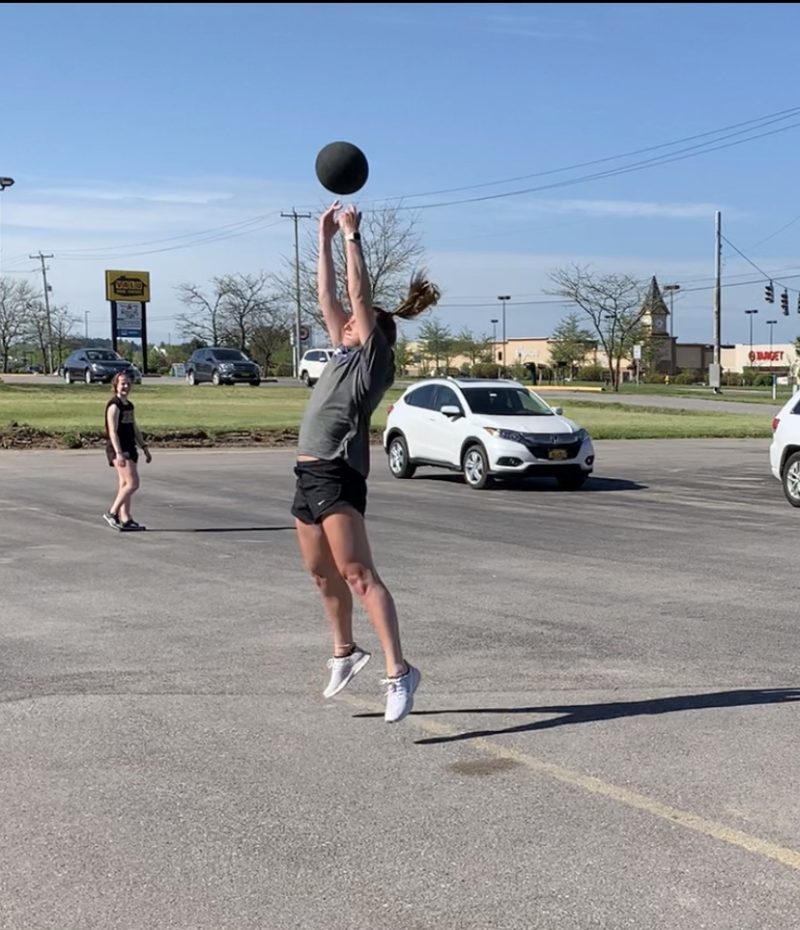
Power – Vertical jumps were tested using the jump mat and a vertec, increases 1.8 inches to 4.7 inches. Broad jumps were also tested, but not with everyone.
- Another way I measured power was through trap bar jumps at varying weights with a tendo unit attached. I used this mainly with the more advanced college athlete, with peak power and peak force improving significantly across the board. I did also track velocity on hang cleans, DB snatches, and Barbell squats.
- I need to start measuring medball throw distance. I used to use the Push band to track velocity on the throws but it’s kind of a pain in the ass. In a perfect world I’d like to use Force plate, medball throw for distance, vert jump, broad jump (unilateral, single response, multi response), and trap bar jumps in assessing “power.”
- I used weighted sled sprints and the prowler more this off-season than in the past. In some specific cases, I went as high as 50-60% of BW in the sled sprints. I definitely under-utilized these in the past. It led to a more seamless transition to feeling what acceleration mechanics should be like. For team sport athletes, I think it’s really undervalued as it’s a very specific way to overload a dominant movement pattern in their sport.
Strength increases might be the thing I care least about as it’s the easiest to achieve and happens as a byproduct of solid, all-around training. Here are some highlights
- Took someone’s one rep max on the bench and turned it to an 8 rep max
- Three high schoolers trap bar deadlifted 2.5x their BW (two male, one female)
- One college male trap bar trap bar 2.8x BW
- Had two collegiate males hit 2.5x BW and 2.4x BW in the squat
- Had a pro athlete pull 2.5x BW in trap bar x 2 reps (plus it being a PR)
- Main lifts were increased by average of 20-60+lbs though we rarely maxed.
- All athletes set bodyweight and weighted pull-up personal bests
- All athletes set new highs in their schools respective lifts.
- Female high school freshman trap bar 315lb, while another female HS senior pulled 330lb.
- Pro lacrosse player bench went from 185->245lb
*It helps when you train athletic people with goals and the drive to accomplish them, so these feats say far more about them, than me or the training.
Rehab
- Fully torn MCL, sprained ACL back to full strength in 6 weeks
- With a fully torn ACL, got an athlete back jogging and performing single leg squats to a bench (still got the surgery, it was postponed due to covid)
- Two rather severe shoulder “impingements” both back benching by end of training
- Lateral epicondylitis in pro lacrosse player, back to no restrictions (we never stopped training)
- Partially torn mcl, sprained MCL, couldn’t walk to playing full basketball season 7 weeks later
- They all just trained. Nothing groundbreaking.
Stamina
- I don’t really subscribe to the majority of the way people test “fitness.” To each their own. I think the problem with the entire conversation there is context. Is the goal hitting the practitioners textbook definition of fitness, or does the person need to be in the best condition to repeat high intense efforts over a specific time? The aerobic work should reflect the context of said goal, if it’s generic running, then the coopers test is reasonable for example.
- You can also use heart rate recovery and measure HR for 60 seconds after activity (bike, rower, circuit), this way we can align it more with applicable activities. Also leaning on resting heart rate or heart rate variability to give you extra feedback too.
- For my athletes, if I can increase weekly tempo volume, while they maintain velocity and HR stays where I want, I know we are progressing as they’re able to increase workload without a decrease in performance. After all, isn’t that the goal? Lastly, I am constantly getting their feedback on how they are performing in their sport, which I place far more value on than an aerobic running test.

Leave a Reply