
Your Movement Screen is Probably Wrong
If you wasted thousands of dollars securing some utterly meaningless three letter acronym next to your name, the title likely upsets you. I don’t blame you. Nobody likes throwing money in the trash.
People are infatuated with perceived “complexity.” If it’s complex and seemingly difficult to understand, it must be valuable! Right.
This gave birth to ridiculous programs like Brookbush’s “movement dysfunction” and Functional Movement Screens.
Let me ask you this though…
These courses/programs all assume their own acceptable standards of how movements should look or be executed. Often, these are rather rigid definitions and are solely up to the discretion of who invented the course. Reliable, right?
What’s the issue?
Movement is PURPOSELY variable. This makes the entire movement system resilient. We can accomplish the same motor task in thousands of different variations. So when you’re watching someone move, appreciate that the possibilities are infinite and imperfect, therefore, what are you really grading it based on?
Here’s an example:
I have a completely atrophied, non-functioning infraspinatus on my dominant side. My suprascapular nerve, for whatever reason, feeds my Supraspinatus but stops short at the Infraspinatus. It has been this way for over 20 years now. Yet, I was able to play and excel in overhead sports, eventually playing collegiate tennis. My fastest serve came in at 131 mph, which I imagine any PT or Physio would have said would be unlikely if they assessed me as a young athlete.
My body adapted to perform the tasks of my sport, by dispersing the forces to other areas and altering my mechanics. In a sport that produces a fair amount of asymmetries to begin with, my body took it to the extreme.
It wasn’t until this “dysfunction” was pointed out to me that I started to become aware of how it MIGHT impact my game. I started to overthink my swing, could I possibly be stable enough without the full power of my rotator cuff? If I missed, was it the fault of my shoulder? This created a host of issues that didn’t exist before.
Dr. Mel Siff
“Simply because posture is poor does not mean its pathological. Nor does it mean a person with visually poor posture undoubtedly will suffer from more musculoskeletal problems. Simple isolationist mm testing of trunk or any other muscle cannot determine if one’s muscles will be operating inefficiently or in some state of imbalance in actual multi-angular sporting activity.”
“Anything that creates greater awareness of optimal patterns of stability or mobility can help to improve motor skills, posture, and movement efficiency! Awareness training more than any given exercise or therapeutic regime on its own is likely to have a greater impact on improving posture than anything else.”
The “Functional” Movement “Screen” (eye-roll)
- Do Functional Movement Screen (FMS) composite scores predict subsequent injury? A systematic review with meta-analysis (2017) – Conclusion: The strength of association between FMS composite scores and subsequent injury does not support its use as an injury prediction tool.
- Why screening tests to predict injury do not work—and probably never will…: a critical review. – “Unfortunately, there is currently no example of a screening test for sports injuries with adequate test properties. Given the nature of potential screening tests (where test performance is usually measured on a continuous scale from low to high), substantial overlap is to be expected between players with high and low risk of injury. Therefore, although there are a number of tests demonstrating a statistically significant association with injury risk, and therefore help the understanding of causative factors, such tests are unlikely to be able to predict injury with sufficient accuracy.”
Dr. Moshe Feldenkrais
“The brain could not think without motor functions. Thinking of a movement triggers the movement – even if subtly. Imagining counting would trigger subtle movements in the vocal apparatus. Anger – clenched fists and teeth. Every thought leads to a change in the muscles.
“The BODY is NOT a machine with parts. The sensory system is intimately related to the movement system, not separate from it. Sensations purpose is to orient, guide, help control, coordinate and assess the success of a movement. Kinesthetic sense accesses success of a movement and gives immediate sensory feedback.”
“Don’t you decide how to do the movement; let your nervous system decide. It has millions of years of experience.”
Learning > Grading
You want to encourage the brain to problem solve, not discourage it. This is why using constraints has become so popular in training or athletics. If you want someone to get better at dribbling with their left arm, you can’t just say, “dribble with your left more!” Well, you could, but good luck.
You could make them play with their right arm behind their back. You could set up a game where scoring with your left gets you 4 points and only 2 points for your right. You can have your defenders line up purposely towards their right, forcing them to go left. In any of the examples above, the constraint you use doesn’t tell the person what they have to do, it tells them what they can’t do. They are then forced to problem solve.
Your conscious brain can’t be too heavily involved in trying to execute movements, this just leads to stiff, awkward movements. Typically, when you put someone through your “assessments,” they are performing movements they’ve never done before, while they think way too much about you starring at them. What do you expect?
Should I judge your coordination by your ability to perform a left-handed lay-up? What if you’ve never done a lay-up?
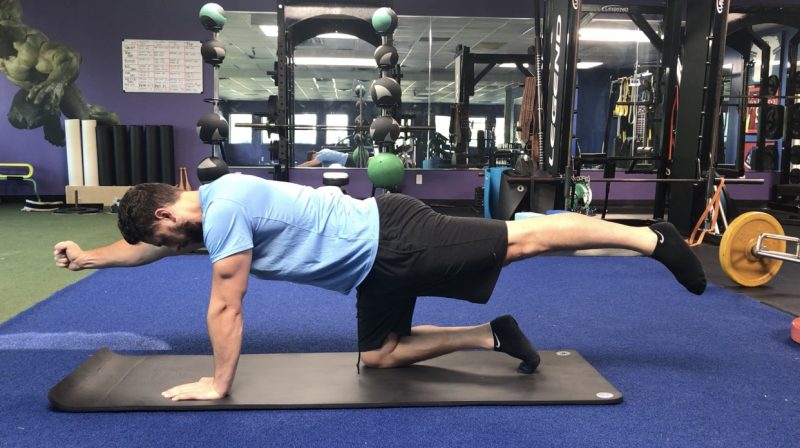
Should I judge your “stability” by performing a bird-dog? Most people have never done this in their life.
In Closing
If you proudly wear your three-letter acronym with pride, you likely let others think for you. I imagine life is pretty relaxing for you, as thinking is often difficult and discouraging. I hope this article leaves you with more questions than answers.
Just remember, the next time you’re “judging,” “assessing,” or “grading” a movement, that there are more interactions going on in your body than stars in the universe. Meanwhile, you’re trying to look at one, and then make sweeping generalizations from it…

Leave a Reply