
Slow-Wave Sleep, Aging, and Growth Hormone
While weight training lured me into the profession, my curiosity spilled over into other pockets in health, performance, anti-aging, and longevity. As technology advances and science evolves, it’s a race to keep up with all of the latest research and ideas. Here’s some interesting reading on slow-wave sleep and aging.
Slow-Wave Sleep
The importance of sleep cannot be overstated as there appears to be a strong association between sleep and mortality. [1] Sleep deprivation has deleterious effects on metabolic health, cognitive function, and can lead to an impaired immune response [2].
Typically sleep is broken down into two categories – REM (rapid eye movement) sleep and nonREM (NREM). Experts in this field maintain that though there are five stages to sleep, it’s more appropriate to view it as a gradual transition or a wave-like rhythm.
Stage 3 and 4 are referred to as “deep sleep”, and this is where we see slow-wave sleep. Slow-wave sleep is thought to play a role in memory consolidation and “cerebral restoration and recovery” [2]. Researchers from UC Berkley recently confirmed that boosting slow-wave sleep could restore memory as we age. Yet as we age, we often experience a reduction in sleep quality. Why?
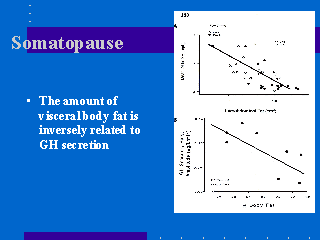
In my previous article I talked about, “andropause”, a period where men experience an age-related decrease in testosterone. Now, meet the next shitty part about aging – somatopause. Somatopause is the age-related decline in growth hormone and insulin-like growth factor 1. Growth hormone deficiency is associated with fat gain, loss of muscle mass/strength, and a decrease in exercise capacity, as well as a host of other issues.
There’s an interesting study that found reduced amounts of slow-wave sleep played a role in reduced growth hormone secretion. [3] 60-70% of daily growth hormone secretion occurs during slow-wave sleep. The mean percentage of slow-wave sleep decreased from roughly 18% during early adulthood, to 3.4% during mid-life.
That’s quite a dramatic drop. It is often replaced by lighter stages of sleep (1 and 2). In separate studies when they pharmacologically enhanced SW sleep, growth hormone secretion increased.
The authors hypothesize that, “the decline in slow wave sleep from early adulthood to midlife was paralleled by a major decline in GH secretion”. [3] Increased age was also associated with higher morning cortisol hormones (your stress hormone), again likely due to decrease SW sleep.
Could we boost this through GH supplementation? It’s an interesting concept. This might be where peptides, a newer sensation in the drug world, offers some benefits, specifically the GHRP (Growth Hormone Releasing Peptide) class.
I don’t have much more of a solution here other than understanding the importance of sleep and doing your part to make sure you prioritize it. I often recommend my clients buy an Oura ring as it provides exceptional details on your sleep and gives you the data necessary to make changes.
[1] https://www.ncbi.nlm.nih.gov/pmc/articles/PMC2856739/
[2] https://www.ncbi.nlm.nih.gov/pmc/articles/PMC2824210/
[3] https://jamanetwork.com/journals/jama/fullarticle/192981

Leave a Reply