
Exercises to Improve Acceleration
Acceleration is inherent in every sport we play. Field and team sport athletes spend almost all of their time in the acceleration zone (0-30m), and often their first few steps are what separates them from the competition.
If a basketball player can create separation within the first 1-2 steps, he’ll have a clear lane to the basket. If a soccer player beats you in their first few steps, they’ll likely end up with the ball and in an offensive position. So while nobody loves developing max velocity, or top end speed more than me, you’re doing a disservice if you aren’t addressing acceleration as well.
When you breakdown the kinematics and kinetics of acceleration, you’ll have a better idea on how to develop this skill.
For example, we know that there’s horizontal and vertical forces from the start of a sprint, but the scale is tipped more towards horizontal due to the orientation of the body (forward lean). So you’ll typically pair this with exercises that train horizontal force production and pliometrics with deeper knee bends as this is more relevant to the start of a sprint.
Get Stronger
Strength is the driving factor in the first 10 yards as the athlete must overcome inertia and produce enough ground reaction force (GRF) to propel themselves forward. As movement velocity picks up, the athlete spends less and less time on the ground. So the first portion of the run will feature longer ground contact times (GCTs), which means more time to generate force.
This is why someone who just has a base level of strength can perform decent in a 10yd sprint, but as the sprint continues, other factors become more important (Power, Speed, Elasticity) and they’ll fall behind.
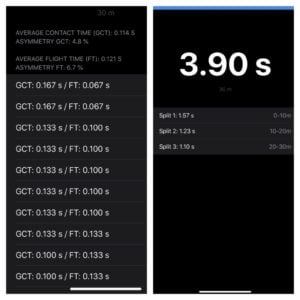
Let’s look at the image below. Ground Contact Time decreased as the run went on, while flight time (time in the air) increased. More force into the ground, more time spent in the air as the ground returns that force back to us. This is a good time to remind you that it take .3-.4 seconds to generate maximum force, whereas sprinting occurs at speeds far greater than that (.08 or .10 in the example below). Because of this, you are in a time deficit or as Zatiorsky calls it, “explosive strength deficit“. So while strength matters, it’s only a piece of the puzzle.
Exercises to Improve Acceleration
1.) SPRINT.
Run 5’s, 10’s, 20’s, etc. Add medball throws to the sprint, weighted sprints, or banded sprints as well. The weighted sled and banded runs will allow the athlete to lean into the weight and optimize a more horizontal driven acceleration.
2.) Explosive Medball Throw
Medball throws are great for developing starting and accelerative strength with higher velocities than we can typically achieve in the weight room. They are also easy to teach and track (distance of throws).
3.) Isometric and Pliometric Exercises
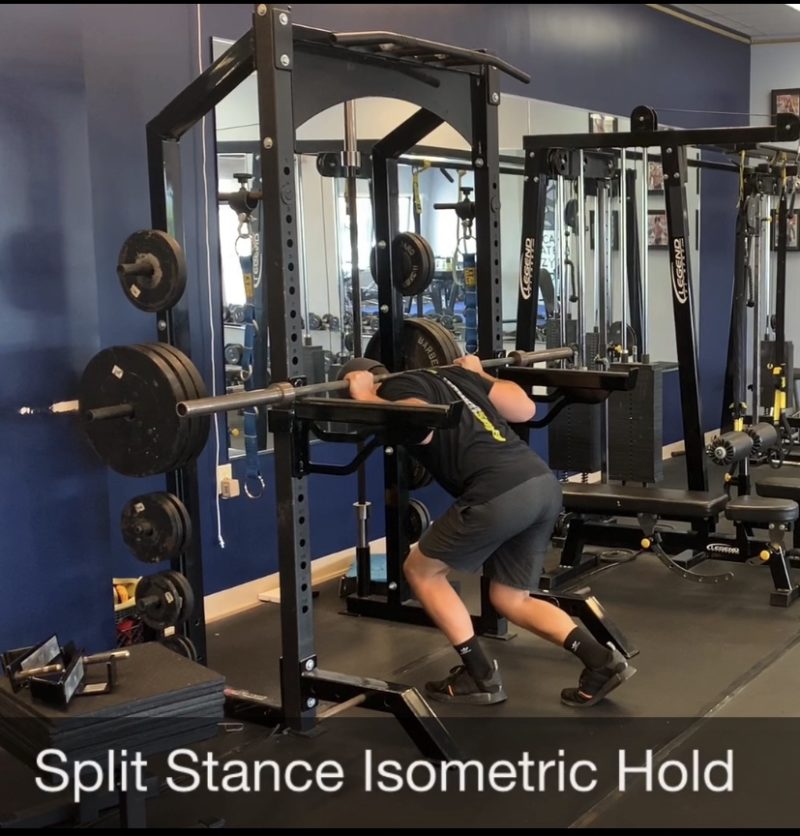
Isometrics can be used in rehabilitation or performance situations. They’re useful in allowing us create high tension, maximal contractions in specific ranges of motion. Coaches will often use this to test Rate of Force Development (RFD) in tests like the Isometric Mid-Thigh Pull (IMTP). Recently there’s been an interest in isometrics ability to potentiate and increase muscle activation, which you can then pair with a dynamic exercise like the video below.
4.) Strength Exercise (Concentric Dominant)
General strength training will make up the majority of your weight lifting in the GPP phase. Variations like the exercise below can be used when trying to train different joint angles or lean towards more starting/accelerative strength (dead stop).

Leave a Reply