
Whenever I start to put together a presentation, I accumulate a ton of content and then there’s some spill over. Of course I’d love to sit there and talk about training all damn day, but that would bore most everyone there.
In June, I’ll be hosting a seminar at my facility on the principles I feel are most important for coaches/clinicians today. It’s hard to narrow this down and I know that a lot of important content will be left out.
So, while I still plan on addressing pain in certain facets, some of the research I gathered for my presentation just didn’t make the cut. Rather than leaving it in my chaotic, stuffed-to-the-brim “random ideas” folder, I’ll list it out here. This isn’t quite an article, more like, check out this random, useful shit.
Feldenkrais Quote(s)
- “Feldenkrais found, repeatedly, that when a body part is injured, its representation in the mental map becomes smaller or disappears. He relied on the work of the Canadian neurosurgeon Wilder Penfield, who showed that the surface of the body is represented in the brain by a map. Both the size of an individual body part in the brain map is proportional not to its actual size in the body but rather to how often and how precisely it is used. If the body part performs a simple function – the thigh, for example, mainly does one thing, moving the knee forward – the representation is small. But brain maps for the fingers, often used in precise ways, are huge. Feldenkrais understood that it is a use-it-or-lose-it brain, and that when parts are injured – and thus are not used often – their representation in the brain map decreases. By making very finely tuned – differentiated – movements of these parts and paying close attention while doing so, people experience them subjectively as becoming larger; they take up more of their mental maps, and lead to more refined brain maps.”
- “Most conventional treatments assume that function is wholly dependent on the “under-lying” bodily structure and its limitations. Feldenkrais discovered that his pupils’ difficulties were caused as much by how their brains learned to adapt to their structural abnormalities as by the abnormalities themselves.”
Knowledge is power – It’s important that we take the time to educate our clients/patients.
- “This study shows that preceding a bout of exercise with pain education can alter pain responses after exercise.” (Jones, MD et al. J Pain 2017)
Once you realize that pain is a normal, inescapable truth of having a complex, adaptable system (body), you can better cope with its existence. Patient/client education is crucial in that it builds trust, gives power to the client, and provides context for their current situation. Personally, I’ve found the cup analogy from Greg Lehman to work extremely well here.
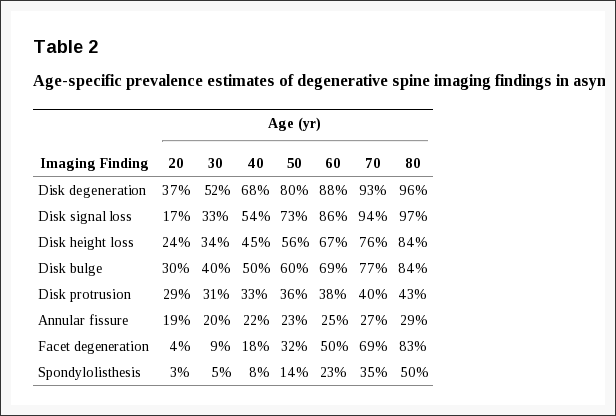
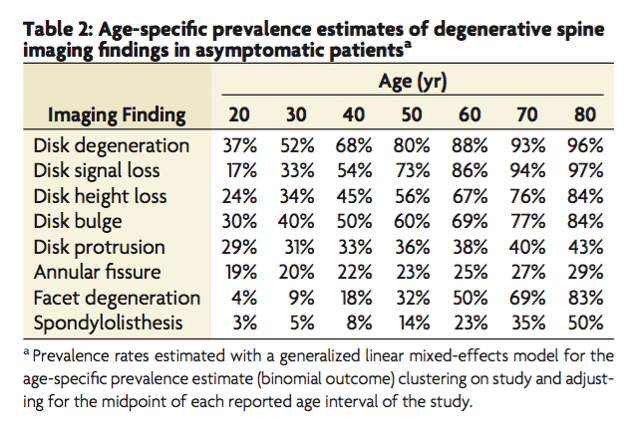
For example, let’s say you have a client who after experiencing some back pain went and got an MRI which found “degeneration”. We know that early MRI’s lead to worse outcomes in low back pain, but that’s besides the point. What if you told them that 80% of 50 year olds displayed disk degeneration with no symptoms? What if you told them that it wasn’t a death sentence? That degeneration is normal and does not have to equal pain or limitation. What if you told them that you’ve gotten tons of people with far worse MRI’s out of pain? You educated them, gave them hope, and started the recovery process. Start there.
Check out the image below. That is the prevalence of spinal degeneration findings in people with NO symptoms.
Take a drug? Use a passive modality? Use exercise/movement for pain? Focus on lifestyle?
“Mechanical Loading Mitigates Osteoarthritis Symptoms By Regulating Endoplasmic Reticulum Stress and Autophagy”
- “Previous study showed that in early stage OA, knee loading exerts protective effects by suppressing osteoclastogenesis…”
- “Mice subjected to mechanical loading exhibited resilience to cartilage destruction…as well as a decrease in synovitis…mechanical loading restored chondrogenic differentiation.”
- “These results demonstrate that mechanical loading can retard pathologic progression of OA at its early AND late states”
“Exercise Increases Interleukin-10 Levels both Intraarticularly and Peri-synovially in patients with Knee Osteoarthritis: A Randomized Controlled Trial”
- 31 Female subjects with OA split into exercise or no exercise group
- 25 sets of 10 @ 60% vs. None
Findings:
•Significant increase in Interleukin (IL) – 10 was discovered in the knee in the Ex group for over 2 hours, (IL-10 stationary in non-ex group)
•“Exercise caused an increase in both intraarticular and peri-synovial concentrations of IL-10…This suggests a positive effect of exercise on chrondroprotective anti-inflammatory cytokine response.”
“Krause, A.J. et al. The pain of sleep loss: A Brain characterization in humans (2019)”
- “Sleep loss not only amplifies the pain-sensing regions in the brain, but blocks the natural analgesic-centers too”
- “Another key brain region found to slow down in the sleep deprived brain was the insula, which elevates pain signals and places them in context to prepare the body to respond”
- “The injury is the same, but the difference is how the brain assesses the pain without sufficient sleep”
Take Home Points
• As we know, loading and proper doses of stress can exert analgesic and protective benefits in those with arthritis. Exercise!!
• Sleep is the most powerful, simple, under-utilized therapeutic, anabolic and recovery agent. Don’t gloss this over.
• Let your patients/clients have some skin in the game. Give them knowledge and let them play a role in the healing process.

s ray ogra
Great insights Dr. Fred! I’ll likely steal some of that, esp the ‘age vs imaging finding’ data. Indeed, the pre-biasing we routinely see in pts who have their own anatomic information without the more important clinical context and background put clinicians behind before we’ve even begun.