

Generating Passive Income with Options
I was never a math all-star, but that hasn’t stopped me from trying to learn new things. While there are far more complex ways to use options (like the million different spreads – iron condor, back/ratio, vertical, etc.), I’m going to touch on the easiest and most simple.
My two favorite ways to generate passive income are selling covered calls and selling puts. By using these, you can make money without buying or selling a single share.
Here’s how.
Call Options
Even though this article is about selling calls, you need to understand both sides of it.
Buying Calls – A call option is a contract that gives the buyer the right, but not the obligation, to buy a stock at a specified amount (strike price) by a certain date (expiration). 1 contract = 100 shares. Buying a call is a bullish strategy, as you believe the stock price will go up.
Example 1
Currently, Apple is trading at roughly $155/share. Let’s say you believe they are going to have a strong September and go much higher. You might buy 1, September 17th, $160 option for .60/contract or $60 (because .60 x 100 = 60).
- If Apple closes at $160 or above on September 17th, you have the option to buy 100 shares at $160 or, you can just sell your option and walk away with the difference between what you paid and what the current premium is (as the share price goes up, so will the premium on the option).
- If it closes lower, you lose the upfront premium you paid (.60 or $60), but don’t have to buy any shares.
Let’s say the price goes to $170, you have the option to buy 100 shares at $160, which instantly gives you a profit of $10 a share ($1,000 profit), or sell your call back for the same profit, without ever having to buy the shares.
This strategy allows you to bank on potential upside, without having to spend as much as buying the shares outright. Because remember, 100 shares of apple at $155 is $15,500 vs. buying 1 contract (equal to 100 shares) for $60.
Buying calls is extremely popular, but carries more risk than selling covered calls.
Example 2
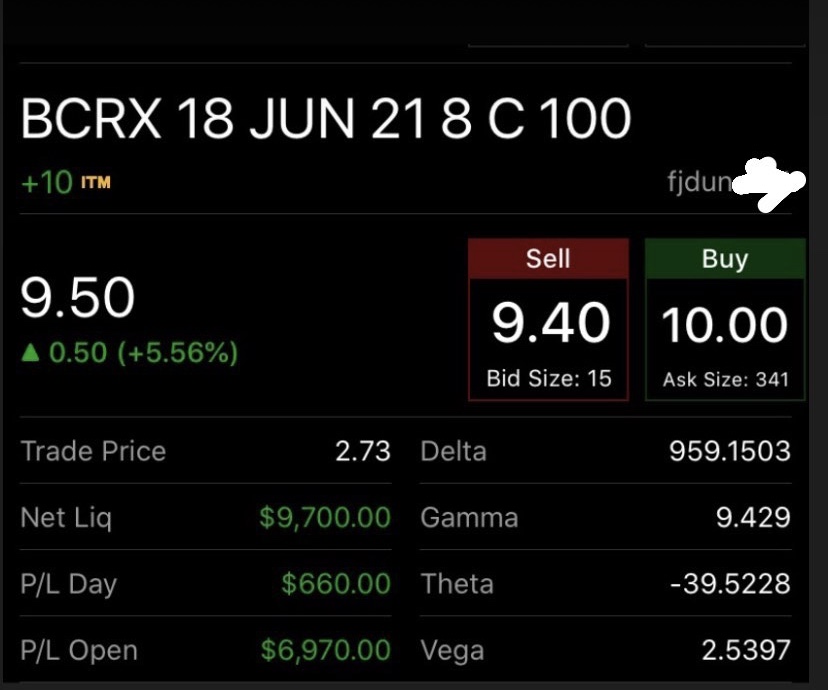
I bought 10, June $8 options for $2.73/contract when the price of BCRX was around 10.75. Each contract is the right to buy 100 shares, so 10 contracts = 1,000 shares.
This cost me $2.73 x 1,000 = $2,730.
You might ask. Why not just buy shares? Well, if I wanted 1,000 shares (10 contracts worth) at $10.75, that = $10,750 vs. what I paid, which was $2,730. Yet, the upside at the end will be the same.
These calls ended up being worth $9.70/each (because the share price went above $17).
$9.70 x 1,000 = $9,700
So my profit was $9,700 – $2,730 (initial investment) = $6,970
So rather than spending $10,750 to make the same $6,970, I spent $2,730 instead.
Selling Covered Calls
Selling or “writing” a covered call is an agreement to sell a portion (each contract is 100 shares) of your position at an agreed upon price (strike price), by a specific date (expiration), for an upfront payment (premium).
If the stock does not hit the agreed upon price by the date, you (the seller), get to keep your shares and the upfront premium you were paid.
If the stock does close above the agreed upon price by the date, you sell your shares for the specific price and still get to keep the premium.
Win-Win.
For example, my largest position is in Biocryst (BCRX), a rare disease company with two FDA approved drugs and an up and coming drug (Factor D inhibitor) that could be a multi-billon dollar product.
I currently have 18,000 shares. Depending on the stock, there are monthly or even weekly options. In the case of BCRX, there are only monthly options.
For the month of September, I wrote calls against 15,000 shares of mine (and sold puts, more on that later).
The option chain for September goes from $1 -> $30 – those are the strike prices.
Early last week, the stock climbed from $15.50 to $16.30. That day, I sold 150, September 17th, $18 calls for .25/contract (You try to sell on days that are positive and there is a lot of trading volume or implied volatility).
I’m essentially betting that by the close of September 17th (which is 3 weeks away), the price will not be higher than $18. If it is, then I sell 15,000 shares for $18, plus keep what I was already paid (the equivalent to selling at $18.25).
The person on the other end is betting the price will be higher than $18 and wants in on the potential upside without having to put down what 15,000 shares would cost. If it closes at 17.90, his options expire worthless and he loses the premium he paid (.25/contract).
I wrote calls against 15,000 shares, which means I sold 150 contracts (150 x 100 = 15,000).
The day I wrote these calls, the premium for the $18 strike price was .20-.25 (bid/ask).
The closer the strike price is to the current share price, the higher the premium. The further away, the lower the premium.
15,000 x .25 = $3,750
So, I instantly get $3,750 in my account and can do whatever I want with that. If the stock closes under $18 on the expiration date (9/17), I keep all of my shares and the $3,750. It’s essentially free money.
Since I sold these, the price is down to $15.70 and the $18 strike premium is far less, considering we are further from hitting $18 by September 17th. I could buy these back (goes beyond the scope of this article), or just sit and ride it out (what I’ll likely do).
Then I will do this again the following month.
You’re likely thinking, “what’s the downside?”
Technically, you limit your potential upside when selling covered calls.
If, for example, BCRX gets bought out for $40/share next Tuesday, I miss out on over 100+% gains because I’ve agreed to sell 15,000 worth at $18. Or, they might have a tremendous two week run and close at $20 on September 17th. I’d miss out on $1.75 worth of gains ($20 – $18.25), though remember, I could technically buy them back during that run, I’d just lose the difference between the premium I accepted vs. what it cost now (it would be higher since it’s closer to $18).
However, I’m not really losing anything though because I’m collecting an upfront premium and still selling higher than the current price ($15.70). I’ve been selling calls for the last year and have not had any shares called away yet.
There are people who get more aggressive and sell closer to the current share price so they collect a higher premium. That’s fine too. I want to keep these shares, so I pick strike prices that are far “out of the money” or away from the current price.
Selling Cash-Secured Puts
Selling puts is another relatively simple strategy that allows for passive income, but does require cash in your account (I don’t recommend selling naked puts unless you’re a true expert). If a call option is the right to buy 100 shares of a stock at the strike price, a put option is the right, but not the obligation, to sell 100 shares at the strike price.
Once again, if you can buy a put, you can also sell one.
Let’s get right to the numbers.
At one point this month BCRX was in the low $14 range. During that time, I sold September 17th, $15 put options, which means if the price closes below $15 on the 17th, I am agreeing to buy 100 shares. The other side of this contract is agreeing to sell 100 shares at $15 if the price is lower than $15 on the 17th.
This is a solid strategy if you want additional shares of a company at a more favorable price.
At the time, the premium was .80 on the $15 puts, so I sold 10 of them (agreeing to buy 1,000 shares if under $15 in 3 weeks). I also sold $14 puts.
$15 Strike – 1,000 (10 contracts) x .80 = $800
$14 Strike – 1,000 (10 contracts) x .60 = $600
Let’s say it closes at $14.95 on September 17th, I will be asked to buy 100 shares at $15. However, if you consider the .80 premium I was given (or $80 per 100 shares), it’s more like buying at $14.20 (15 – .80 = 14.20). So I keep the initial premium and now have 100 more shares of a company I want, at a favorable price.
If it closes above $15, I still keep my premium and don’t have to purchase any shares.
There is still some downside here. Let’s say there’s a black swan event and the market crashes. Maybe BCRX closes at $8 on September 17th. Well, I’d have to buy at $15 and incur an almost immediate loss of $7/share (more like $6.20 if you include the premium). Either way, it would not be ideal.
Just like selling the calls above, you could attempt to buy these back.
Overview
By selling calls and puts this month on BCRX alone, I collected $5,150, without buying or selling a single share. If BCRX closes between $15-17.99 on September 17th, which I expect, I don’t lose any shares nor do I have to buy any, yet I have $5,150 extra in my account and I’m free to do it again next month.
The caveat is that you;
- Need to be approved for options trading (very easy, just apply on your brokerage).
- Need to have a minimum of 100 shares of a position if you’re writing calls against them.
- Need to have enough cash in your account to buy the shares if you sell puts (cash secured puts).
- Need to keep a closer eye on your positions than if you just buy and hold.
- Could blow up your account if you get greedy and make excessively aggressive bets.
If you’re interested in learning more about how to approach investing and how it relates to training, check this out: Complex Systems – How Training is Like Trading
* Side note – I am NOT an expert, nor am I financial planner. Therefore, this is not advice. It is purely educational. I would recommend buying the book McMillan on Options if you truly want to learn more.

Leave a Reply