
Evidence Based Energy System Development for Soccer
STOP drowning soccer athletes in fatigued, middle intensity, non-specific running due to a lack of knowledge! Physical Preparation for Soccer has a lot of common deficiencies, namely their lack of an offseason, reliance on special endurance work and reluctance to value the importance of speed and power in the sport. Soccer is too often trained as an “endurance” sport when it’s primarily ALACTIC-Aerobic!
As the length of a run increases, the speed deteriorates. Therefore, if you are running 400’s and 800’s for your “speed training”, you are clueless! Joel Jamieson found that from 10s-43s there was an average reduction in speed of 11%. This further highlights the importance of alactic training to develop true speed.
Speed kills, right?
So balance on a bosu ball and juggle like a circus act or start practicing something you will ACTUALLY DO on the field – SPRINT!
“Most actions for the scoring player were straight sprints (45% of all analysed goals) followed by jumps (16%), rotations and change-in-direction sprints (6% each). Most sprints were conducted without an opponent and without the ball.”
Another study on female soccer players found that, “Sprint speed was able to distinguish between drafted and non-drafted players.”
There’s also something called speed reserve… the higher one’s max velocity (speed) is, the less energy will be required to support sub-maximal efforts. Then let’s say your max velocity speed is 10 m/s, your 75% capability would be around 7.5 m/s. If you enhance your speed to 11 m/s, you get faster AND your 75% effort run is now 8.25 m/s.
Soccer Game Analysis Studies:
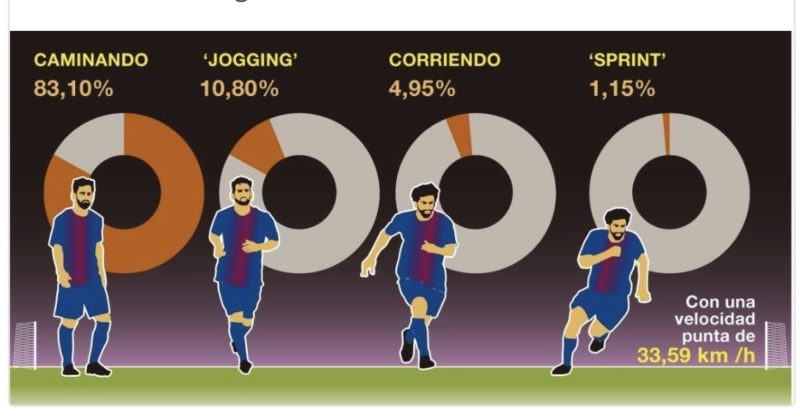
- 70% of time in low intensity, aerobic conditions (walking, backpedaling etc.)
- 30% 15-20m high intense movements
- Sprinting was 5-10% of total distance which came to be 2-4 sec sprint every 90 seconds
- Blood lactate levels were 4.5-5.0 mmol/L which shows lactate metabolism is not too high during a game
- Game analysis on Messi vs. Real Madrid showed 83% walking, and 1.15% sprinting.
- Other studies have shown number of sprints being “14.3 +-6.1,” with runs rarely longer than 20m in distance.
Energy system demands (ESD)
As you can see, it is a game of short bursts of high intense, intermittent efforts (alactic) blended with long periods of low intensity activities (aerobic). This will direct the training.
Goals:
- Improve quality of short bursts of high intense efforts through increased speed and power (Alactic)
- Increase the ability to recover from these efforts in a timely and efficient manner (Aerobic)
- Continue to develop strength among the full Force/Velocity continuum (accelerative strength, speed-strength etc.)
- Improve acceleration and max velocity mechanics to ensure efficiency and minimize energy leaks
- Maintain suppleness of tissue (mobility/flexibility)
Means:
The Alactic system, being the most immediate and shortest lasting (6-12 seconds), is used often in a soccer game. This is why it’s essential to improve alactic power and capacity! “To expand the alactic envelope you must train in the alactic environment.” (Charlie Francis)
- For this reason, true speed work (Alactic power + cpacity), plyometrics, explosive medball throws, and ME/DE weights are used.
- Short ⇒ Long
- Short as it mimics the sport, improves acceleration
- Long for max velocity speed, strength/resilience of hamstrings
Example of a speed session:
- Hill sprints – 1x5x10yd, 2x5x20yds, 1x3x30yds (340 yards total volume) FULL RECOVERIES!
- This is alactic power, so you want maximum output. This is NOT get tired work. 20 and 30yd sprints rest 2-3 minutes after each, and longer between sets.
- Pair with Plyometrics, a form of Dynamic or Ballistic movement (Medball Throw or DB Snatch), and Strength Training.
Having robust Aerobic capacity and power will help replenish the alactic system and maintain the quality of these short efforts. Studies on short, 30s bike sprints, which one would expect to be primarily anaerobic, have shown increased usage of the aerobic system with each successive sprint. If an athlete lacks the adequate aerobic capacity to refill energy, power output must be reduced.
- For this reason, Tempo Runs are used as a way to develop the aerobic enzyme, facilitate recovery, easily track mileage to limit overuse injuries, and improve capillary density (Charlie Francis).
- These use submaximal speeds to improve form by focusing on proper arm action and limiting excessive backside mechanics
- Low intensity, try to stay below anaerobic threshold, this is AEROBIC!
- Total volume typically 2,000-5,000yds per session. Depends on level Youth/Midlevel⇒Elite/Pro and position.
Example of Tempo Run:
- 70% effort, 100-200m (sometimes 300) runs mixed with active recoveries.
- 100-100-200-100-100 x 4 (2,400 total)
- The – is an active movement (ab, mobility, push up) followed by 50yd walk
- After each set walk 100 yards
Meanwhile, the anaerobic system should be used sparingly as its build-up of lactate and H+ impedes recovery and energy production. Therefore, blindly running players for conditioning and performing an abundance of middle intensity, non-specific work, is not optimal.
Plus, you will likely be competing with a head coach who, because he played 15 years ago, believes he knows the bio-energetic demands of the sport and will feature his idea of “fitness”, which falls in this middle, glycolytic zone. For years I have had to reduce the volume of valuable speed/power development in soccer athletes as their head coaches would over work them all week. I will not put gasoline on a fire.
Though please remember, this ignores the demands of the game, isn’t fast enough to improve speed, and must be classified as a high intense effort. Not to mention, this type of training competes for the same adaptive resources that your speed and power training will, thus limiting the effectiveness of both. The anaerobic-lactic system will still improve indirectly through the enhancement of speed/power and work capacity.

Leave a Reply