
In Part 1 of this article, I provided some basic definitions and interesting research on eccentric muscle contractions. In Part 2, I’ll be showing some exercise variations I use and when I implement them.
As I mentioned previously, I like eccentrics in early off-season phases, blocks where I’m trying to help someone gain muscle tissue, and in almost all rehabilitation scenarios. It’s also important to remember how quickly their effects can diminish, per the image in the last article, so I try to fit them in often.
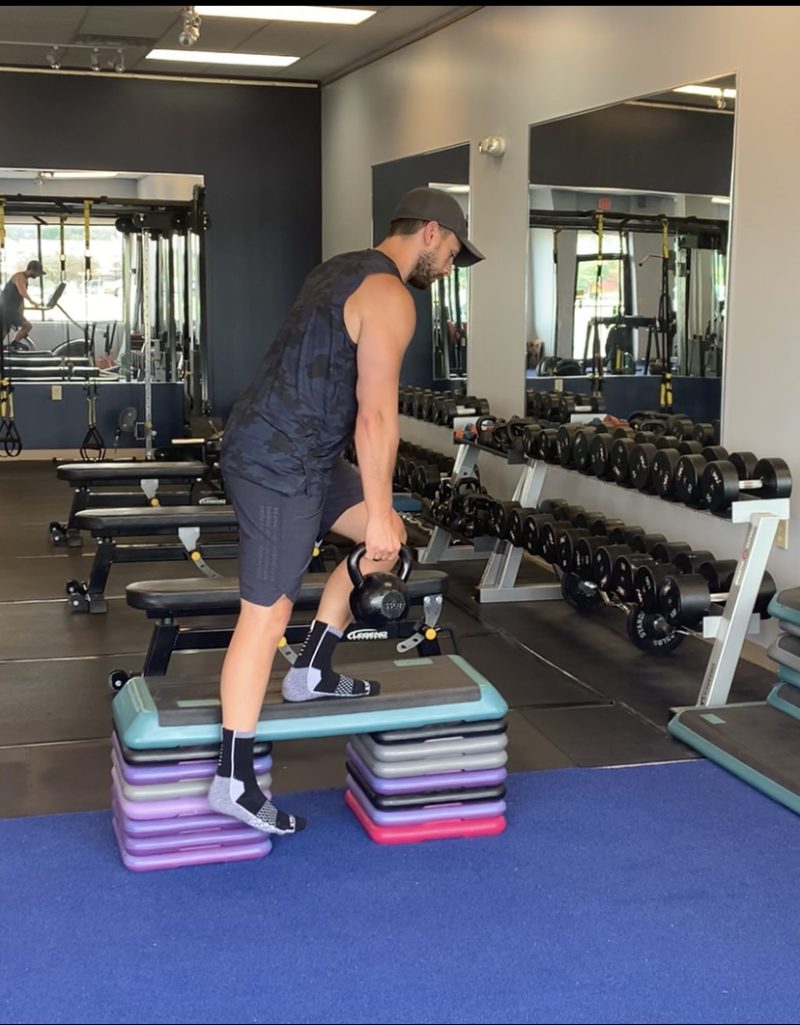
- This first exercise is an Eccentric, Elevated (1 down, 2 up) Peterson Step Down. Since we know that more force can be produced eccentrically, we can overload this portion and build overall robustness of the tissue as we prepare for further stress. I also find myself using this for those with “tight” (tightness is relative and simply just a feeling, but some people are over-developed here vs. posterior), knee/hip rehabilitation, and in sports where the hip flexor demand is high (soccer, hockey, etc.). I feel as though these can provide an performance enhancing effect (increase storage of kinetic energy + type 2x development) and preventative (increase fasicle length + eccentric tolerance).
The specific tempo, sets/reps, are based on my readings on eccentrics + experience using them over the last 10+ years. For this exercise I’ll typically use a 4-8 second eccentric with 6-8 repetitions, 2-3 total sets. In the video I demonstrate two ways to handle the concentric portion – keep the weight and step up with 2, or drop it and then stand with 2.
- The second exercise is a Physioball Eccentric Hamstring Curl (2 up, 1 back). This is a pretty difficult exercise for most people, so it’s not going to be your first course of action. I’ll use this midway through a GPP block or later phase hamstring rehab. I’ll keep the eccentric count lower here, 2-6 seconds, and reps around 4-8.
- The third exercise is a Single Leg Squat to a Bench (1 down, 2 up). Same principle in the first exercise, I’ll pick a load that they wouldn’t be able to do many concentric reps with, and overload the eccentric portion.
This has served me well in rehabilitation as most people can tolerate this quite well, even if standing with one leg was moderately painful. The goal here is to strengthen the tendons/muscle and providing a lengthening to the tissue without aggravating it with a concentric rep.
- I can’t have the whole article being lower body exercises, so I’ve got to work in an upper body variation. I’ve found that plenty of people can benefit from some lengthening exercises for the Lats as this muscle gets a lot of action and can contribute again to the feeling of tightness or even some restrictions in movements. So here’s 2 ways to implement the 2/1 method.
Loaded Eccentric TRX Row (2 up, 1 back)
*The video below is just bodyweight, add a weight vest to load it further.
2 up, 1 down Eccentric Inverted Row

Leave a Reply