
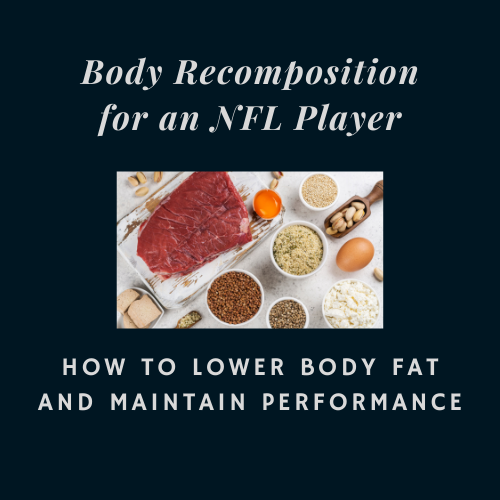
Body Recomposition for an NFL Player
When your calories are a little higher and you’re less worried about body fat, performance gains fall in your lap. This perfect world is called – bliss.
Eventually reality sets in. While this is fun and all, there’s a point where you’ll likely want to drop body fat, put down the ice cream sandwich at night, but not give up all of the gains you made. The age old battle.
Your standard weight gain or weight loss goal is rather simple, this is slightly more specific. You essentially have two goals, and while one is difficult enough, you have two competing goals.
Exercise burns energy to fuel performance. So you need it.
Losing body fat requires less total energy intake. So you need less of it.
Well, fuck. Doesn’t sound promising, right? It’s hard, but there’s always a way…
The Plan
Last week I had an hour phone consult with a current MVP winning, NFL player about his diet. He had a very specific goal. He wanted to hit a certain weight range with 10% body fat, while maintaining or even improving his performance. And I want a Lamborghini, but that’s life. So I gave him an exact outline to follow and then wrote him up a cheat sheet to refer to.
Body Recomposition Protocol
Cliff Notes
- Training heightens insulin sensitivity (improved carbohydrate metabolism), but immediately eating carbohydrates blunts this effect.
- Post-workout, stored glycogen levels will be low
- Glycogen resynthesis will be of upmost importance to the body, so while our cells eagerly await glucose, fatty acids will be deemed as expendable
- Fat becomes the main energy substrate as the body tries to spare glucose
- So there’s muscle building benefits to only protein AND fat reducing benefits
- Farther you are from the workout, keep carbohydrates lower glycemic index, closer can be higher GI
Protocol
- If training with weights or sprinting, always carb up
- The day of weight training (or if you train earlier, 1-2 meals the night before), eat 1 to 4 meals containing carbs + 30-50g protein each meal (limited amounts of fat are OK) prior to training.
- Because of your size (285 and intense training), you should get in 300-600g carbs total depending on experience and how you respond – play around and see how little you can get away with and still have a good workout, or how much you can eat and not put on fat, etc.
- Try to eat the last meal preferably no sooner than 1 hour before the workout.
- Intra-workout I advise a large shaker with water, 5g leucine, l-glycine, l-glutamine, l-alanine
- Post-workout – 60-100g of protein from a low-carb shake or whole food source (I prefer whey or whey hydroslate)
- When you get hungry past that, for the following 5 to 48 hours, consume protein from whole foods, and low to no carbs except from raw or green veggies (I typically use lettuce, broccoli, green beans, etc.)
- Try to consume quality fats (olive oil, MCT oil, coconut oil, avocado oil, fish oil, almonds, almond/peanut butter, whole eggs, grass-fed butter, etc) in those subsequent meals.
- Before your next intense, performance-oriented session, or your next lifting session, preferably the “day of,” repeat the “carb up” process
Why Carbs Aren’t Necessary Immediately Post-Workout (The science)
- To build muscle, protein synthesis (creation) must be > degradation (breakdown)
- Main driver in protein synthesis is amino acid availability
- Insulin is important, but all foods create an insulin response (+ whey protein generates a large one)
- Koopman and colleagues tested three groups of males who underwent resistance training and then either consumed a protein only post-workout drink, protein and low carbs or protein and high carbs. They concluded that “co-ingestion of carbohydrate during recovery does not further stimulate post-exercise muscle protein synthesis when ample protein is ingested.”
- Net balance, which is arguably more important than synthesis alone, was higher in the protein only group. Net balance takes synthesis and degradation into account.
In a recent commentary from the Journal of International Society of Sports Nutrition, the authors pose the question, “Is carbohydrate needed to further stimulate muscle protein synthesis/hypertrophy following resistance exercise?”
Here are some of the key points they discussed:
- “It is true that insulin is needed to increase protein synthesis when amino acids delivery are increased. However, even very low levels of insulinare able to act in concert with leucine to enable protein synthesis.”
- “Leucine ingestion has the ability to stimulate insulin secretion, and protein supplementation studies report a marked increase in circulating insulin concentrations at a minimum of two to threefold above fasting values.”
In regards to studies done on protein versus protein and carbohydrates post-workout, “these studies demonstrate that adding carbohydrate to a protein dose that alone is known to maximally stimulate protein synthesis has no additive or synergistic effect on muscle protein synthesis and breakdown.”

Leave a Reply